


Contrary to popular leadership wisdom, authenticity is not a reflection of how leaders display what is in their hearts or heads.
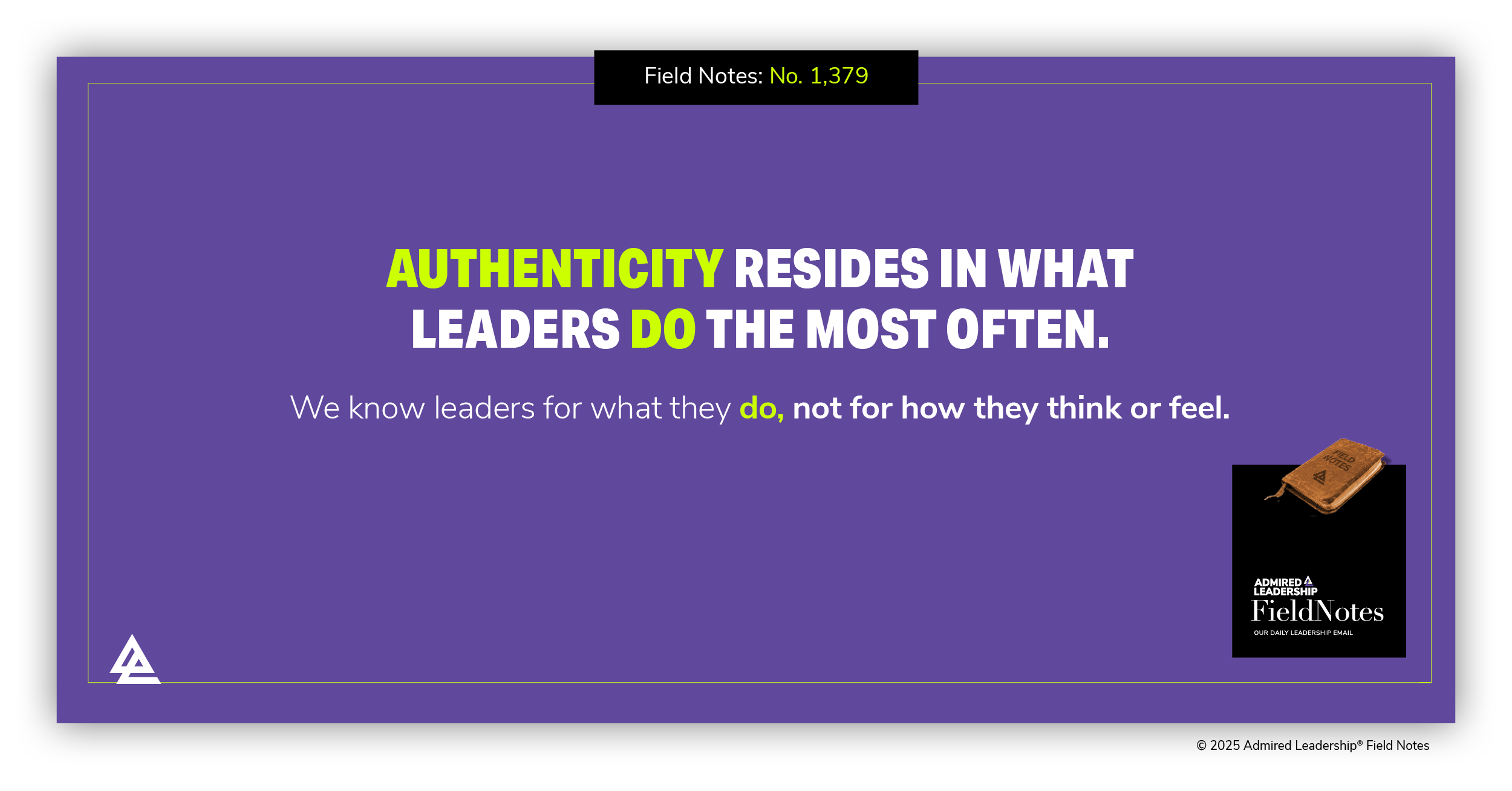
Authenticity resides in what leaders do most often.
For instance, a leader who believes themselves to be compassionate and hopes to display their warmth for others is, in reality, not authentically kind-hearted until they consistently act compassionately.
We know leaders for what they do, not for how they think or feel.
The benefits of authentic leadership are well-known. Team members prefer a leader who is consistent, predictable, and knowable.
By engaging in consistent behaviors — even as the content, situation, and audience change — leaders demonstrate that team members can rely on them to be a steady force.
Of course, leaders with authentically strong qualities are more effective than those with authentic flaws!
The best leaders have learned to strike a balance in how they adapt to situations and people while at the same time engaging in a consistent set of behaviors, actions, and attitudes.
Tailoring their responses too much and too often to meet the needs of a situation or individual can render them inconsistent and, thereby, inauthentic to those who observe them.
The good news is that leaders can learn to adapt and flex in their approach and content while maintaining consistency in their style of expression and action.
The challenge for leaders is not only to strike this balance but also to live with a degree of inauthenticity when they attempt to incorporate a new behavior.
The reality is that any time a leader attempts to incorporate a new behavior they have not previously performed consistently, they are acting inauthentically in the eyes of those they lead.
Leaders who want to build new leadership habits must fight through the skepticism and resistance displayed by team members who wonder why the leader is acting in a way they normally don’t.
The team’s initial conclusion is that the leader must be doing something new to have an “effect” or to influence others, which is not to be rewarded with acceptance or appreciation. This mistrust makes it doubly difficult for leaders to stick with a new behavior.
But without this period of inauthenticity and resistance, leaders can’t grow and develop. This may partially explain why making lasting change in leadership style is so uncomfortable.
Fascinatingly, growth depends on inauthenticity for a time. There’s no way around it.

To Grow, a Leader Needs to Be Inauthentic
SHARE:

Sign-up Bonus
Enter your email for instant access to our Admired Leadership Field Notes special guide: Fanness™—An Idea That Will Change the Way You Motivate and Inspire Others.
Inspiring others is among the highest callings of great leaders. But could there be anything you don’t know, you haven’t heard, about how to motivate and inspire?
Could there really be a universal principle that the best leaders follow? A framework that you could follow too?
There is.
Everyone who signs up for Admired Leadership Field Notes will get instant access to our special guide that describes a powerful idea we call Fanness™ (including a special 20 minute video that really brings this idea to life).